

H12-821_V1.0 PDF Dumps Sep 14, 2026 Exam Questions – Valid H12-821_V1.0 Dumps
Ultimate H12-821_V1.0 Guide to Prepare Free Latest Huawei Practice Tests Dumps
NEW QUESTION # 34
Which of the following protocols are multi-channel protocols?
- A. Telnet
- B. FTP
- C. H.323
- D. SMTP
Answer: B,C
Explanation:
Multi-channel protocols such as H.323 and FTP use separate control and data channels. H.323 uses different channels for call signaling and media streaming, while FTP uses a control channel for commands and a data channel for file transfers. Telnet and SMTP are single-channel protocols .
NEW QUESTION # 35
Which of the following statements regarding the OSPF protocol is false?
- A. Link State ID in a Type 3 LSA indicates the router ID of an ABR.
- B. Routing information can be advertised only between backbone and non-backbone areas and cannot be advertised directly between non-backbone areas.
- C. Each OSPF router uses only one Router-LSA to describe the local active connection status of an area.
- D. Router-LSA describes four connection types: P2P, TransNet, SubNet, and virtual link.
Answer: A
Explanation:
The Link State ID in a Type 3 LSA (Summary LSA) indicates the network or subnet being summarized, not the router ID of an ABR. All other statements accurately describe OSPF functionality, making D the false statement .
NEW QUESTION # 36
OSPF is deployed in a campus to achieve network interoperability, and OSPF is also enabled on the GE0/0/2 interface of R3. Area1 is deployed as an NSSA area, and the addresses of each device are as shown in the figure.
An engineer configured a static route on R3 to access the loopback interface address of R4, and imported the static route into the OSPF process. At this time, in the Type5 LSA received by R1, the forwarding address (FA) is: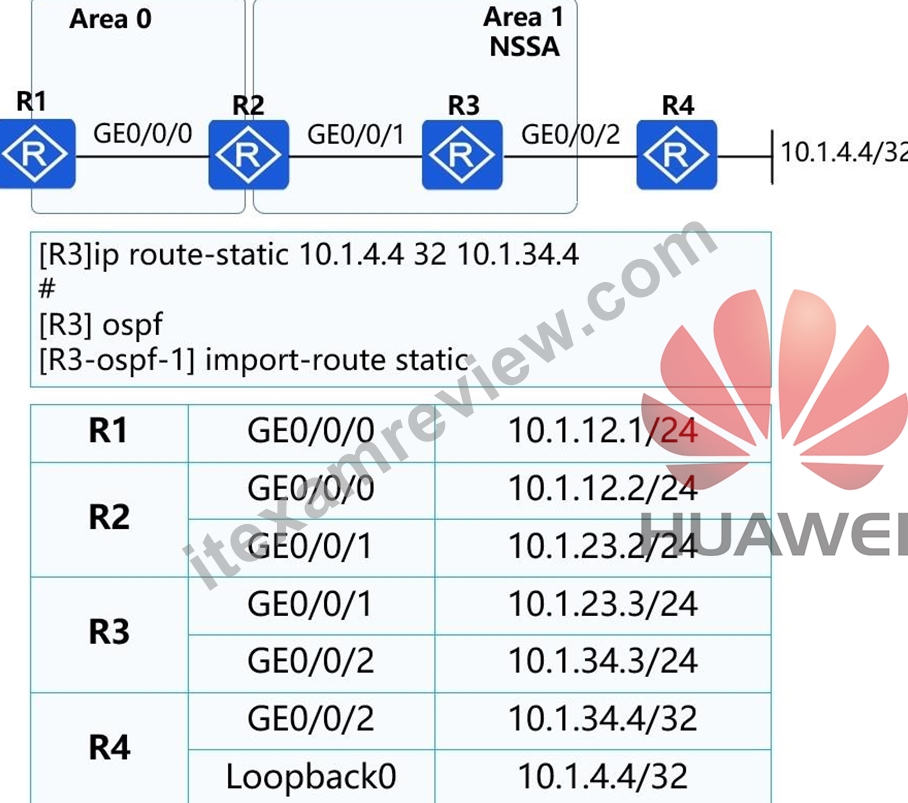
Answer:
Explanation:
10.1.34.4
NEW QUESTION # 37
Which of the following descriptions about the application of RPF in multicast data forwarding is incorrect?
- A. The router will compare the incoming interface of the packet with the RPF interface of the RPF route.
If they are consistent, the RPF check passes, indicating that the source path of the packet is correct and it will be forwarded downstream. - B. When the router receives a multicast message, it first checks the source address of the message, and then selects an optimal route based on the priority of the routing source. The outbound interface of this route is the RPF interface.
- C. During the multicast data forwarding process, the multicast router will perform an RPF check on each received multicast data packet through the unicast routing table.
- D. If the RPF check fails, it indicates that the source path of the packet is wrong and the packet will be discarded.
Answer: C
NEW QUESTION # 38
When configuring an ACL on a router, you can specify a unique number or name to identify the ACL. Once a named ACL is created, it cannot be modified. You can only delete the named ACL and reconfigure it.
- A. TRUE
- B. FALSE
Answer: B
Explanation:
ACL Modification
Named ACLs can be modified after their creation. Unlike numbered ACLs, named ACLs provide greater flexibility for editing individual rules without deleting the entire ACL.
NEW QUESTION # 39
Which of the following SA descriptions about various messages is wrong? (Multiple choice)
- A. LS Update message contains complete LSA information
- B. LS Request message only has LS Type, LS ID and Advertising Router
- C. DD only contains the summary information of the LSA, which includes LS Type, LS ID, Advertising Router and LS Sequence Number
- D. LS Ack message contains complete LSA information
Answer: C,D
NEW QUESTION # 40
Which of the following protocols does not support network configuration management?
- A. SSH
- B. NETCONF
- C. SNMP
- D. LLDP
Answer: D
NEW QUESTION # 41
Which of the following descriptions of the OSPF asbr-summary command is incorrect?
- A. Routes summarized using the asbr-summary command can be flooded to other areas.
- B. The Asbr-summary command can summarize LSAs aggregated by asbr-summary.
- C. The routes summarized using the asbr-summary command will be transmitted within the area as type 5 LSA.
- D. The Asbr-summary command can only take effect when deployed on the ASBRs that need to be aggregated.
Answer: B
NEW QUESTION # 42
BGP can select routes based on the AS_Path attribute. Therefore, in some cases, a route-policy needs to be used to modify the AS_Path attribute for route selection. Which of the following parameters can be specified in the apply as-path command for a route-policy to modify this attribute?
- A. Copy
- B. Delete
- C. Additive
- D. Overwrite
Answer: B,C,D
Explanation:
Comprehensive and Detailed Step-by-Step Explanation:
1. Overview of AS_Path Attribute Modification:
The apply as-path command in a route-policy is used to modify the AS_Path attribute of routes. This is often required to influence the selection of routes or to adjust routing policies for incoming or outgoing BGP updates.
2. Parameters of the apply as-path Command:
Option A: Delete
* Correct.
* The delete parameter removes specific AS numbers from the AS_Path attribute. This is used to simplify or manipulate the AS_Path for specific routing policies.
Option B: Additive
* Correct.
* The additive parameter appends an AS number to the existing AS_Path attribute, instead of overwriting it. This is useful when you want to prepend AS numbers to influence route selection without removing the original AS_Path.
Option C: Copy
* Incorrect.
* The copy parameter is not supported in the apply as-path command for modifying AS_Path attributes.
Option D: Overwrite
* Correct.
* The overwrite parameter replaces the existing AS_Path with a new one. This provides complete control over the AS_Path attribute but removes the original AS_Path entirely.
3. Summary:
The valid parameters for the apply as-path command are delete, additive, and overwrite.
NEW QUESTION # 43
Four routers run IS-IS and have established adjacencies. The area IDs and router levels are marked in the following figure. Which of the following statements is true?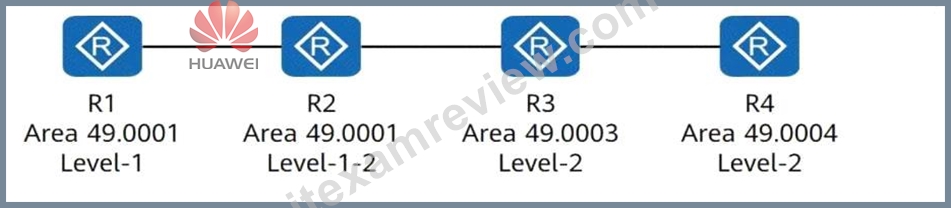
- A. The LSDB of R2 does not contain the LSP of R4.
- B. The LSDB of R2 does not contain the LSP of R3.
- C. The LSDB of R3 does not contain the LSP of R4.
- D. The LSDB of R1 does not contain the LSP of R4.
Answer: D
Explanation:
R1 is a Level-1 router in Area 49.0001, while R4 is in Area 49.0004. Level-1 routers only maintain LSDBs for their own area and do not contain LSPs from other areas, such as R4's LSP.
R2 is a Level-1-2 router, so it maintains LSDBs for both Area 49.0001 (Level-1) and Level-2 domains, which include LSPs from R4.
R3 and R4, as Level-2 routers, exchange LSPs with each other within the Level-2 domain.
Thus, the LSDB of R1 does not include R4's LSP .
NEW QUESTION # 44
Which of the following descriptions of IGMP Snooping are correct? (Multiple choice)
- A. IGMP Snooping runs at the link layer and is a multicast constraint mechanism on Layer 2 Ethernet switches. It is used to manage and control multicast groups.
- B. After IGMP Snooping is enabled, the switch will only send multicast packets to specific multicast receivers and will not flood the entire broadcast domain.
- C. IGMP Snooping can encrypt multicast data packets to avoid data leakage
- D. IGMP Snooping. Does not consume the switch's CPU
- E. IGMP Snooping builds a MAC multicast address table by listening to IGMP messages sent by hosts.
Answer: A,B,E
NEW QUESTION # 45
During BGP route summarization configuration, the keyword can be used to suppress all specific routes so that only the summary route is advertised.
The summary route carries the Atomic-aggregate attribute rather than the community attributes of specific routes.
Answer:
Explanation:
suppress-spec-map
Explanation:
Understanding BGP Route Summarization:
In Border Gateway Protocol (BGP),route summarizationis a technique used to aggregate multiple specific prefixes into a broader summary prefix. This reduces the size of routing tables and improves routing efficiency.
Summarization helps to hide unnecessary details from other parts of the network while still maintaining connectivity.
HCIP-Datacom-Core Technology Training Material (BGP Route Summarization).
Suppressing Specific Routes:
When summarizing routes, thesuppress-spec-map keywordis used to suppress specific prefixes so that only the summarized route is advertised.
The suppressed routes are not advertised to BGP peers; instead, only the summary route is propagated.
Reference:HCIP-Datacom Advanced Routing & Switching Technology (BGP Attributes and Summarization Techniques).
Atomic-Aggregate Attribute:
The summary route generated during BGP route summarization carries theAtomic-aggregateattribute. This attribute indicates that the summary route might not provide the exact path information available in the original specific routes.
Additionally, when using thesuppress-spec-mapoption, the specific routes' attributes, such ascommunityattributes, are not included in the summary route.
Reference:HCIP-Datacom-Core Technology Training Material (BGP Path Attributes).
Conclusion:
Thesuppress-spec-mapkeyword is used to suppress specific routes when performing BGP summarization. The summarized route includes theAtomic-aggregateattribute but does not carry community attributes from the suppressed routes.
NEW QUESTION # 46
Huawei modular devices have multiple hardware modules that provide different functions. Match the following hardware modules with their functions.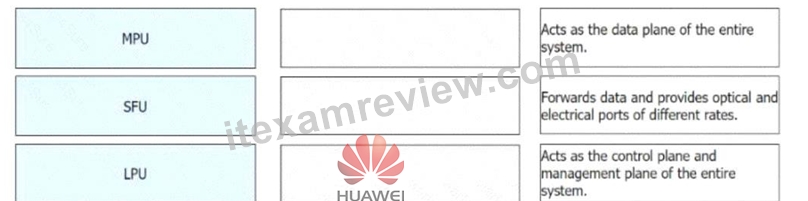
Answer:
Explanation: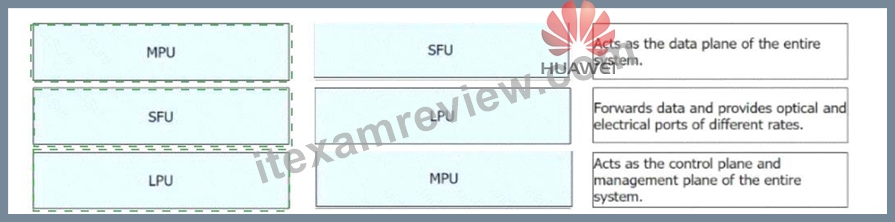
Explanation:
The hardware modules of Huawei modular devices and their functions are:
* Main Processing Unit (MPU): Provides control and management planes for the entire system, responsible for protocol processing, system security, and software upgrades.
* Switch Fabric Unit (SFU): Provides the data plane, enabling high-speed data switching between service modules.
* Line Processing Unit (LPU): Manages data forwarding, offering various interfaces (optical and electrical) for data access.
NEW QUESTION # 47
A switch runs MSTP. The configuration is shown in the figure. What is the role of this switch in MSTI 1?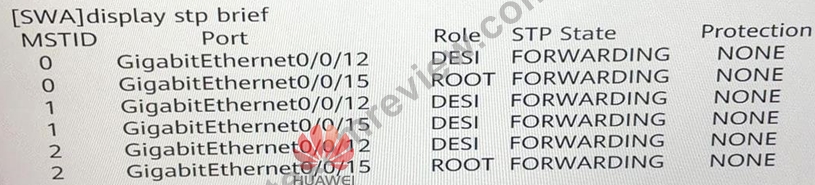
- A. Non-root switch
- B. Root switch
- C. Uncertain
- D. Secondary root switch
Answer: C
Explanation:
Based on the MSTP configuration shown, the role of the switch in MSTI 1 cannot be determined without additional details about the topology or priority values of other switches in the instance. The role could be a root switch, secondary root, or non-root, depending on these factors .
NEW QUESTION # 48
Which of the following descriptions of the application of route reflectors in BGP are correct? (Multiple choice)
- A. The routes learned by the RR from the client are only published to all non-clients of this RR.
- B. RR publishes the routes learned from EBGP peers to all non-clients and clients.
- C. The routes learned by the RR from non-client IBGP peers are published to all clients of this RR.
- D. When the RR receives the route from the peer, it only selects the best route for reflection.
Answer: B,C,D
NEW QUESTION # 49
OSPF networks are classified into four types of networks by link layer protocol. Drag the following link layer protocols to the corresponding network types.(Token is reusable)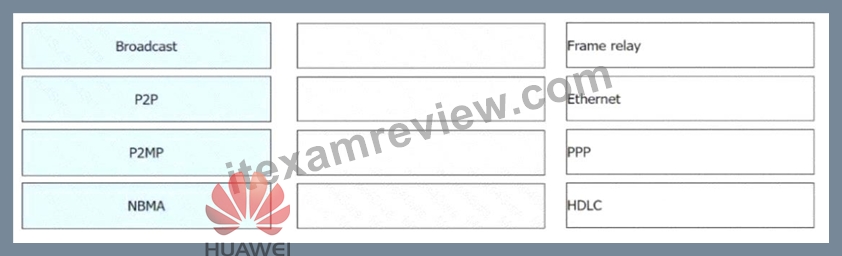
Answer:
Explanation: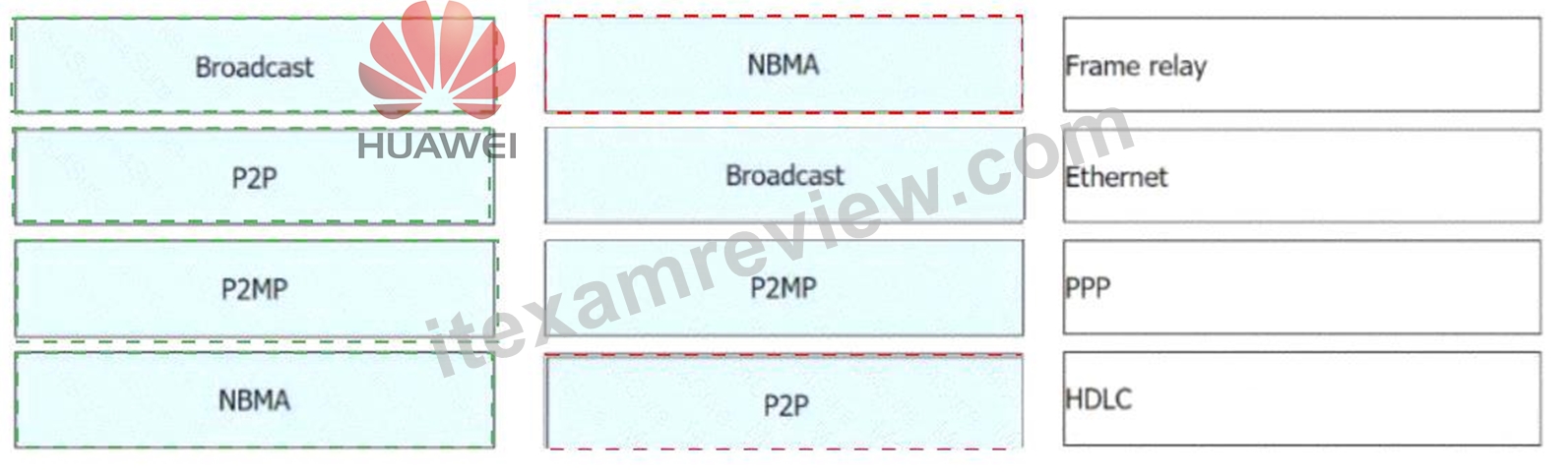
Explanation:
Network Types and Corresponding Link Layer Protocols
* Broadcast: Ethernet
* Point-to-Point (P2P): PPP, HDLC
* Point-to-Multipoint (P2MP): PPP
* Non-Broadcast Multi-Access (NBMA): Frame Relay
OSPF Network Types:OSPF classifies networks based on link layer protocols into the following types:
* Broadcast: This type assumes that all routers on the network can communicate directly with one another using multicast or broadcast frames. Ethernet networks are typical examples.
* Point-to-Point (P2P): This type is used for links that connect two routers directly. Common protocols include PPP (Point-to-Point Protocol) and HDLC.
* Point-to-Multipoint (P2MP): This type simulates multiple point-to-point connections over a single physical network, often used in WAN scenarios where PPP is employed.
* Non-Broadcast Multi-Access (NBMA): These networks connect multiple devices but lack native broadcast capability, such as Frame Relay.
NEW QUESTION # 50
In the network shown in the figure, the R1 device is configured with route penetration. Then the R1 device sends the LSP of Level 1-2 to R3 so that R3 can learn the entire network route.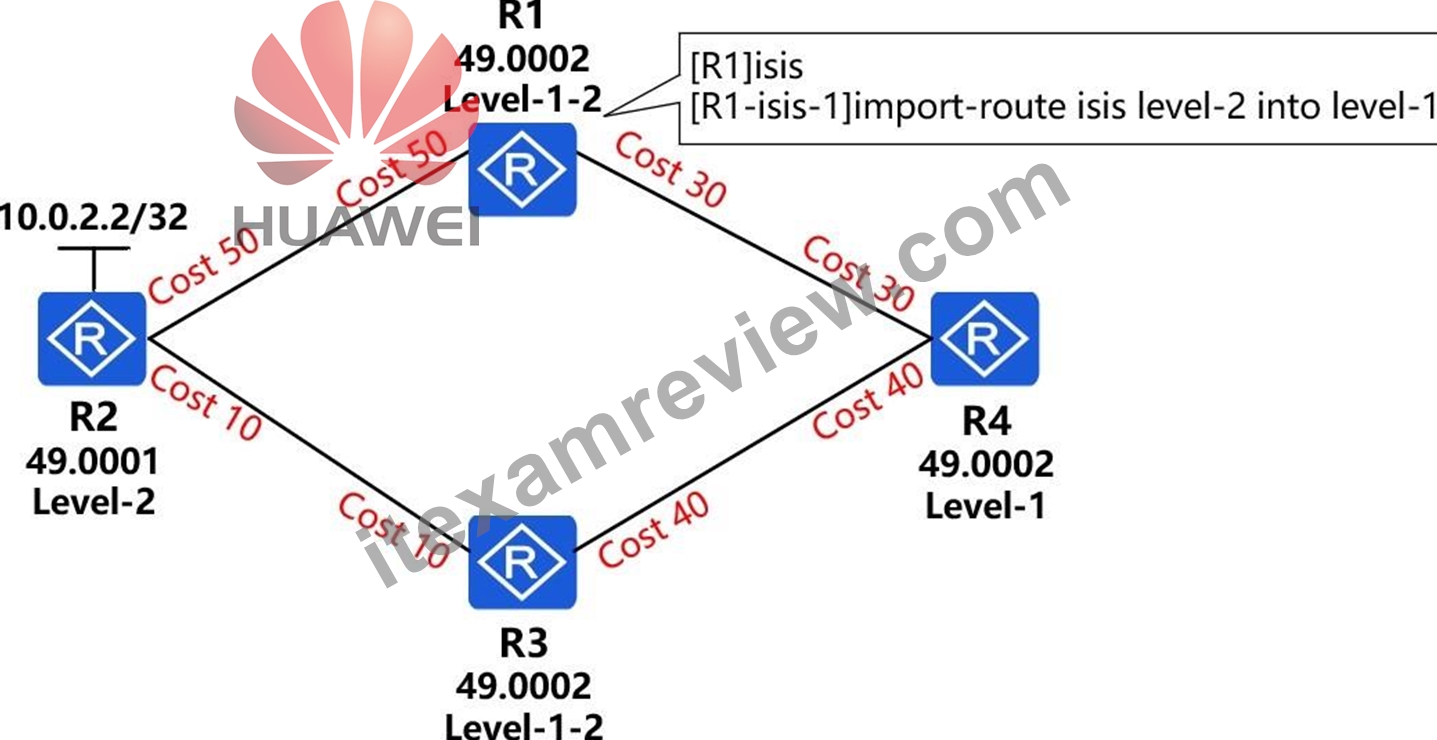
- A. TRUE
- B. FALSE
Answer: A
NEW QUESTION # 51
When configuring dual-link hot backup in a WLAN network, the larger the value of the configured AC priority, the higher the actual priority of the AC.
- A. TRUE
- B. FALSE
Answer: B
NEW QUESTION # 52
On an OSPF network, if two indirectly connected routers with the same router ID run in the same area, Type 1 LSA calculation fails.
- A. TRUE
- B. FALSE
Answer: A
Explanation:
Comprehensive and Detailed In-Depth Explanation:
* Type 1 LSAs (Router LSAs) are generated by every OSPF router to describe its directly connected links and their states.
* The Router ID (RID) must be unique in an OSPF domain; otherwise, OSPF calculations will fail due to ambiguous paths.
* If two routers in the same area have the same Router ID, OSPF will fail to calculate Shortest Path First (SPF) correctly, leading to routing inconsistencies.
* To prevent this, Huawei routers automatically detect duplicate Router IDs and prevent OSPF from functioning properly until the issue is resolved.
# Reference: Huawei HCIA-Datacom Study Guide, Chapter on OSPF LSAs and Router ID Uniqueness.
NEW QUESTION # 53
Which of the following descriptions of BGP features are correct? (Multiple choice)
- A. Periodic routing updates
- B. Use TCP as the transport layer protocol
- C. Can support MPLS/VPN applications and deliver customer VPN routes
- D. Able to carry large amounts of routing information and support large-scale networks
Answer: B,C,D
NEW QUESTION # 54
Regarding the description of configuring the security level of the security zone of the firewall, which of the following is wrong?
- A. The newly created security area, the system defaults its security level to 1
- B. Security levels can only be set for custom security areas
- C. In the same system, two security zones are not allowed to configure the same security level
- D. Once the security level is set, it is not allowed to change
Answer: A
NEW QUESTION # 55
......
Passing Key To Getting H12-821_V1.0 Certified Exam Engine PDF: https://www.itexamreview.com/H12-821_V1.0-exam-dumps.html
Get Top-Rated Huawei H12-821_V1.0 Exam Dumps Now: https://drive.google.com/open?id=1YzqsGldSuGAWwr6G93JcwDs4jnZr1PWF
