

Huawei H12-821_V1.0 Exam Prep Guide: Prep guide for the H12-821_V1.0 Exam
2025 New Preparation Guide of Huawei H12-821_V1.0 Exam
NEW QUESTION # 560
There are hosts running various IGP versions in the current network. The corresponding S multicast group address ranges of hosts of different versions are different. But its function is to receive multicast information from the specified source.
- A. FALSE
- B. TRUE
Answer: B
NEW QUESTION # 561
As shown in the picture, four routers run IS-IS, and they are all Level1-1-2 routers. The area numbers are as shown in the picture.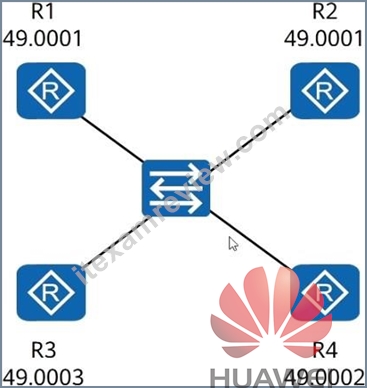
Which of the following statements is correct? (Multiple choice)
- A. R3 and R4 establish Level-1 and Level-2 neighbor relationships at the same time
- B. R1 and R2 can only establish a neighbor relationship of Level1-1.
- C. R1 and R3 can only establish neighbor relationships at Level 1-2.
- D. R1 and R4 can only establish Level-2 neighbor relationships.
Answer: C,D
NEW QUESTION # 562
On the VRP platform, when we introduce IS-IS routing into the OSPF protocol, if COST is not specified, the cost value will be set to 20 by default.
- A. TRUE
- B. FALSE
Answer: B
NEW QUESTION # 563
Which of the following description of the permanent multicast address is wrong?
- A. All routers running the PIM protocol listen on 224.0.0.100
- B. All routers listen on 224.0.0.2
- C. All hosts and routers in the network segment listen to 224.0.0.1
- D. All routers running OSPF protocol listen on 224.0.0.5
Answer: A
NEW QUESTION # 564
VRF, also called VPN instance, is a network virtualization technology that helps VPN technology to isolate users. In normal cases, multiple VPN instances can be created on a physical device, and each VPN instance has independent entries. Which of the following resources can be independently owned by a VPN instance?
- A. Routing table
- B. Routing protocol process
- C. MAC address table
- D. Interface
Answer: A,B,D
Explanation:
Comprehensive and Detailed Step-by-Step Explanation:
1. What is VRF (Virtual Routing and Forwarding)?
* VRF is a network virtualization technology that enables multiple isolated routing tables to coexist on a single physical device.
* Each VRF instance is independent, which ensures separation between different VPNs or users.
2. Resources That VRF Can Independently Own:
Option A: Interface
* Correct.
* Each VRF instance can have its own set of interfaces. These interfaces are bound to a specific VRF, isolating traffic at the physical or logical port level.
Option B: Routing table
* Correct.
* VRF instances maintain independent routing tables. This ensures that routes for one VPN do not overlap or interfere with routes of another VPN.
Option C: MAC address table
* Incorrect.
* The MAC address table is part of Layer 2 operations and is shared by all VRF instances on the device.
VRF operates at Layer 3 and does not isolate MAC address tables.
Option D: Routing protocol process
* Correct.
* Each VRF instance can run its own routing protocol processes (e.g., OSPF, BGP), and these processes are completely independent of other VRF instances.
3. Summary:
* The correct resources that can be independently owned by a VRF instance are Interface, Routing Table
, and Routing Protocol Process.
Reference:
Huawei HCIA-Datacom Study Guide, Chapter "VPN and VRF Concepts."
NEW QUESTION # 565
In BGP routing rules, routes with higher MED values are given priority.
- A. TRUE
- B. FALSE
Answer: B
NEW QUESTION # 566
Which of the following descriptions about MQC flow classification are correct? (Multiple choice)
- A. When the relationship between the rules is set to "AND", when the traffic classification contains ACL rules, the packet must match one of the ACL rules and all non-ACL rules
- B. Setting rules can set "and" and "or" at the same time
- C. The relationship between the rules in the traffic classification is "or" by default
- D. When the relationship between the rules is set to "or", when there is no ACL rule in the traffic classification, the packet must match all non-ACL rules
Answer: A,C
NEW QUESTION # 567
On an office network of an enterprise, OSPF is enabled on two directly connected routers. During adjacency establishment, the state machine stays in the 2-way state. Which of the following statements are not possible causes?
- A. Area IDs are different.
- B. Hello time values are different.
- C. The N-bit and E-bit of Hello packets are the same.
- D. Router IDs conflict.
Answer: C,D
Explanation:
Comprehensive and Detailed Step-by-Step Explanation:
* OSPF State Machine:
* OSPF adjacency progresses through several states: Down > Init > 2-Way > ExStart > Exchange
> Loading > Full.
* The 2-Way state indicates that routers have exchanged Hello packets but are not forming full adjacencies.
* Possible Causes for Staying in the 2-Way State:
* Hello Time Values Are Different (A): Mismatched Hello/Dead intervals prevent adjacency establishment.
* Area IDs Are Different (B): OSPF routers must belong to the same area to establish adjacency.
* Router IDs Conflict (C): While Router ID conflicts cause other issues, they do not result in the
2-Way state.
* N-bit and E-bit Are the Same (D): Matching N-bit/E-bit values are normal and do not cause problems.
References:
* HCIA-Datacom Study Guide, Chapter: OSPF Adjacency Establishment
* Huawei OSPF Neighbor State Analysis
NEW QUESTION # 568
BGP can select routes based on the AS_Path attribute. Therefore, in some cases, a route-policy needs to be used to modify the AS_Path attribute for route selection. Which of the following parameters can be specified in the apply as-path command for a route-policy to modify this attribute?
- A. Overwrite
- B. Copy
- C. Additive
- D. Delete
Answer: A,C,D
Explanation:
Comprehensive and Detailed Step-by-Step Explanation:
1. Overview of AS_Path Attribute Modification:
The apply as-path command in a route-policy is used to modify the AS_Path attribute of routes. This is often required to influence the selection of routes or to adjust routing policies for incoming or outgoing BGP updates.
2. Parameters of the apply as-path Command:
Option A: Delete
* Correct.
* The delete parameter removes specific AS numbers from the AS_Path attribute. This is used to simplify or manipulate the AS_Path for specific routing policies.
Option B: Additive
* Correct.
* The additive parameter appends an AS number to the existing AS_Path attribute, instead of overwriting it. This is useful when you want to prepend AS numbers to influence route selection without removing the original AS_Path.
Option C: Copy
* Incorrect.
* The copy parameter is not supported in the apply as-path command for modifying AS_Path attributes.
Option D: Overwrite
* Correct.
* The overwrite parameter replaces the existing AS_Path with a new one. This provides complete control over the AS_Path attribute but removes the original AS_Path entirely.
3. Summary:
The valid parameters for the apply as-path command are delete, additive, and overwrite.
:
Huawei HCIA-Datacom Study Guide, Chapter "BGP Route Policies."
BGP Attribute Modification in Huawei Documentation.
NEW QUESTION # 569
As shown in the figure, the four Huawei switching devices have all run and configured the MSTP protocol. Now it is required that the MSTP domain name is set to Huawei.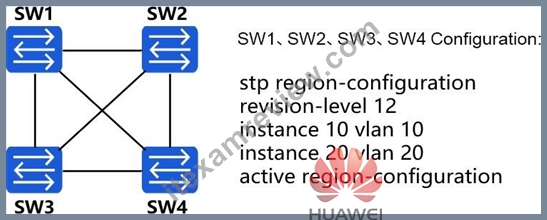
Which of the following commands need to be configured on the four devices? (Multiple choice)
- A. Region-name Huawei
- B. Stpregion-configuration
- C. Domain Huawei
- D. Activeregion-configuration
Answer: A,B,D
NEW QUESTION # 570
As shown in the figure, VRRP is associated with a BFD session. When a backup device detects a fault through BFD, the backup device immediately assumes the master role after the Master_Down_Timer timer expires.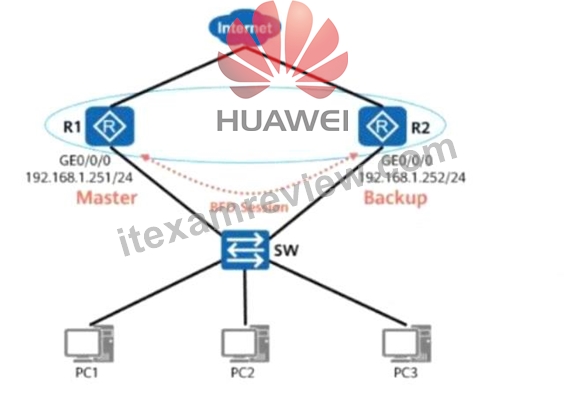
- A. TRUE
- B. FALSE
Answer: B
Explanation:
VRRP and BFD Association:
* VRRP (Virtual Router Redundancy Protocol) is used to provide gateway redundancy by electing a master and backup router.
* Associating VRRP with BFD (Bidirectional Forwarding Detection) allows faster detection of faults on the master device or the link between the master and the backup.
NEW QUESTION # 571
On an OSPF network, one router with P2P as the network type is directly connected to another router with P2MP as the network type. If the Hello intervals on the two routers are changed to be the same, neighbor relationship establishment and LSDB synchronization are not affected.
- A. TRUE
- B. FALSE
Answer: B
Explanation:
The scenario describes a mismatch in OSPF network types between two connected routers: one set to Point-to- Point (P2P) and the other set to Point-to-Multipoint (P2MP). While aligning Hello intervals may seem sufficient for establishing an OSPF neighbor relationship, the fundamental mismatch in network types introduces issues.
OSPF Network Types
P2P: Assumes a direct connection with a single neighbor, uses faster convergence and simpler LSDB synchronization.
P2MP: Supports multiple neighbors on a single interface, requiring different handling for DR/BDR roles and LSDB updates.
Impact of Network Type Mismatch
If Hello intervals are aligned, adjacency establishment might occur. However, mismatched network types affect neighbor role assignment and LSDB synchronization.
P2P expects a direct link and would handle updates differently than P2MP, which assumes multiple neighbors. This leads to inconsistencies in route calculation and forwarding.
HCIP-Datacom-Core Reference
OSPF Basics and Configurationclearly outlines the criticality of consistent network type configuration for stable OSPF operation.
Lab examples in the HCIP Datacom Lab Guidefurther demonstrate the consequences of such mismatches, including unstable neighbor states and incomplete LSDB synchronization.
Hence, the statement that neighbor relationships and LSDB synchronization remain unaffected is incorrect.
Proper OSPF operation requires matching network types in addition to aligned Hello intervals.
NEW QUESTION # 572
On an OSPF or IS-IS network, the filter-policy import command can be run on a router to filter out the LSAs forwarded by its neighbors.
- A. TRUE
- B. FALSE
Answer: B
Explanation:
Comprehensive and Detailed Step-by-Step Explanation:
1. Understanding LSA Filtering in OSPF and IS-IS:
* The filter-policy command is used in OSPF and IS-IS to control which routing information is imported into the local routing table or advertised to other neighbors.
* However, it cannot filter LSAs forwarded by neighbors. In OSPF and IS-IS, LSAs are always forwarded unchanged within the area to ensure all routers have a consistent link-state database.
* Filtering only affects the routes that are installed into the local routing table or advertised to other areas or neighbors.
2. Why the Statement is False:
* LSAs are forwarded without being filtered. This ensures link-state protocols maintain the same network topology view across the network.
* The filter-policy import command only controls routes that are installed into the local routing table, not the forwarding of LSAs.
3. Summary:
* The statement is FALSE because LSAs cannot be filtered by filter-policy import.
:
Huawei HCIA-Datacom Study Guide, Chapter "OSPF Route Filtering."
RFC 2328: OSPF Version 2, LSA Propagation Rules.
NEW QUESTION # 573
R1 contains the configuration shown in the figure.
Isis 1
Cost-style wide
Network-entity 49.0022.ee8c.a0c2.baf2.00
Which option is correct for the following description of IS-IS process 1?
- A. The device type of R1 is Level-2
- B. The device type of R1 cannot be determined
- C. The device type of R1 is Level-1
- D. The device type of R1 is Level-1-2
Answer: D
NEW QUESTION # 574
Regarding the description of LSA header information in OSPF AS -External ?LSA, which is wrong?
- A. Net mask indicates the network mask of the destination network segment
- B. Forwarding Address is always 0.0.0.0
- C. Advertising Router indicates the Router ID of ASBR
- D. Link State ID indicates the destination network address
Answer: B
NEW QUESTION # 575
As a next-generation wireless technology, Wi-Fi 6 greatly improves bandwidth rate and performance. Which of the following statements isfalseabout the features of Wi-Fi 6?
- A. Uses OFDMA technology to achieve high concurrency.
- B. Uses TWT technology to reduce terminal power consumption.
- C. Provides high bandwidth, up to 9.6 Gbps.
- D. Realizes zero latency, ensuring efficient service running.
Answer: D
Explanation:
Comprehensive and Detailed Step-by-Step Explanation:
1. Features of Wi-Fi 6:
Wi-Fi 6 (802.11ax) introduces several new technologies to improve network efficiency, reduce latency, and optimize power usage:
OFDMA (Orthogonal Frequency Division Multiple Access):Allows multiple devices to transmit simultaneously, improving concurrency.
TWT (Target Wake Time):Reduces power consumption by scheduling communication times for devices.
High Bandwidth:Supports up to 9.6 Gbps, significantly faster than Wi-Fi 5.
2. Why Zero Latency is Incorrect:
While Wi-Fi 6 reduces latency compared to earlier standards,zero latencyis not achievable due to inherent delays in network communication.
The statement "Realizes zero latency" is misleading and technically inaccurate.
3. Analysis of Each Option:
Option A: Uses OFDMA technology to achieve high concurrency.
Correct (True Statement).
OFDMA is a core feature of Wi-Fi 6 that improves concurrent communication.
Option B: Realizes zero latency, ensuring efficient service running.
Incorrect (False Statement).
Wi-Fi 6 reduces latency but cannot eliminate it entirely.
Option C: Provides high bandwidth, up to 9.6 Gbps.
Correct (True Statement).
Wi-Fi 6 supports a theoretical maximum bandwidth of 9.6 Gbps.
Option D: Uses TWT technology to reduce terminal power consumption.
Correct (True Statement).
TWT schedules communication times, allowing devices to enter low-power states and conserve battery life.
4. Summary:
Thefalsestatement isB, as Wi-Fi 6 does not achieve zero latency.
Reference:
Huawei HCIA-Datacom Study Guide, Chapter "Wi-Fi 6 Technology."
IEEE 802.11ax Standard Documentation.
NEW QUESTION # 576
......
Latest Questions H12-821_V1.0 Guide to Prepare Free Practice Tests: https://www.itexamreview.com/H12-821_V1.0-exam-dumps.html
H12-821_V1.0 Practice Exam - 1265 Unique Questions: https://drive.google.com/open?id=14JjXf_UDFg2L5AOISMtZuXVtGAINLidj
