

[Sep 26, 2025] ITexamReview JN0-363 dumps & JNCIS-SP sure practice dumps
Juniper JN0-363 Actual Questions and Braindumps
To prepare for the JN0-363 certification exam, IT professionals can take advantage of a range of resources, including study guides, practice exams, and online training courses. By studying these materials and gaining hands-on experience with service provider routing and switching technologies, IT professionals can increase their chances of passing the exam and earning their certification.
Juniper JN0-363 exam is an important certification exam for IT professionals who want to specialize in service provider routing and switching. Passing JN0-363 exam will demonstrate that the candidate has a deep understanding of the technologies and concepts that are relevant to the service provider industry. Service Provider Routing and Switching, Specialist (JNCIS-SP) certification will open up new career opportunities and will help IT professionals to advance their careers.
NEW QUESTION # 39
Click the Exhibit button. You have two routers connected over a Gigabit Ethernet link as shown in the exhibit It is required that an IS-IS adjacency be established without the need for a designated intermediate system (DIS)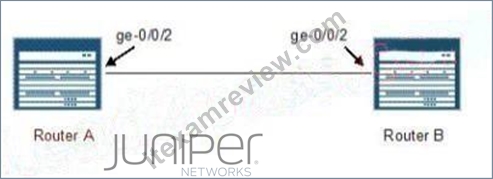
Which configuration statement entered on both routers will achieve this goal?
- A. set protocols isis interface ge-0/0/2.0 no-dis
- B. set interface ge-0/0/2 unit 0 family iso no-dis
- C. set protocols isis interface ge-0/0/2.0 point-to-point
- D. set interface ge-0/0/2 unit 0 family iso point-to-point
Answer: C
NEW QUESTION # 40
Click the Exhibit button. Given the OSPF topology shown in the exhibit, how many unique link-state databases are present in the network?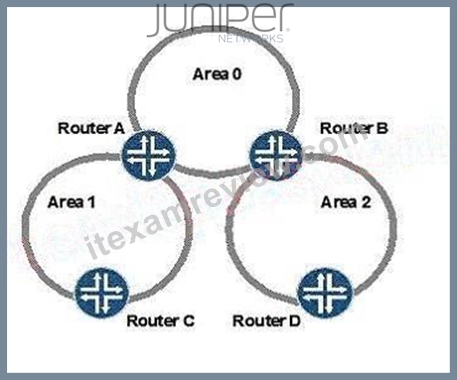
- A. 0
- B. 1
- C. 2
- D. 3
Answer: A
NEW QUESTION # 41
Click the Exhibit.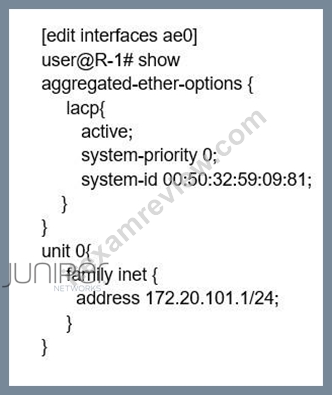
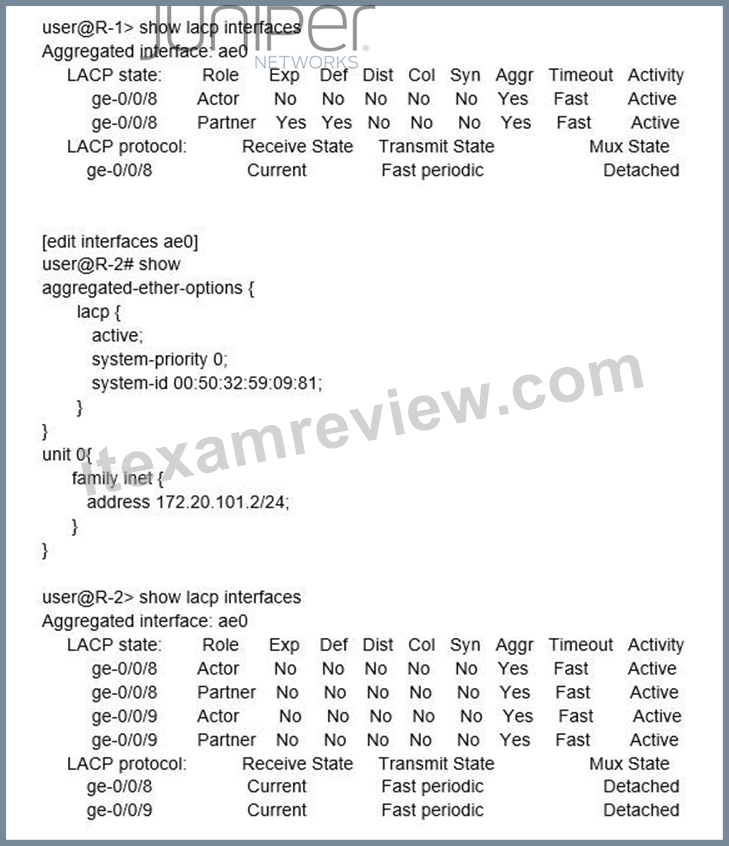
Referring to the exhibit, R-1 and R-2 are connected with a LAG on the ae0 interface.
However, the LAG is not operational.
Which action will solve this problem?
- A. Set the LACP system priority to a non-zero value on one device.
- B. Set the LACP system priority to a non-zero value on both devices.
- C. Change one device to use LACP passive mode.
- D. Change the system ID on one device.
Answer: D
NEW QUESTION # 42
Which new field is added to an IPv6 header as compared lo IPv4?
- A. version
- B. checksum
- C. flow label
- D. fragment offset
Answer: C
Explanation:
The IPv6 header includes a new field that is not found in the IPv4 header, called the flow label. The flow label in IPv6 is used to identify packets that require special handling by routers for quality of service (QoS) or other reasons, allowing these packets to be handled efficiently as they move through the network.
Reference:
Juniper Networks Technical Documentation on IPv6
IPv6 Header Fields - Juniper Networks
NEW QUESTION # 43
Which two routing protocols make use of a designated router, or pseudo node, to represent a broadcast network? (Choose two.)
- A. IS-IS
- B. OSPF
- C. MPLS
- D. BGP
Answer: A,B
NEW QUESTION # 44
Which two statements are correct about the service provider MPLS network shown in the exhibit? (Choose two.)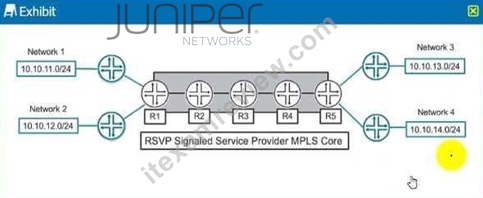
- A. R3 is considered a PE router.
- B. R3 is considered a transit router.
- C. R3 is considered an ingress router.
- D. R3 is considered a P router.
Answer: A,D
NEW QUESTION # 45
Click the Exhibit.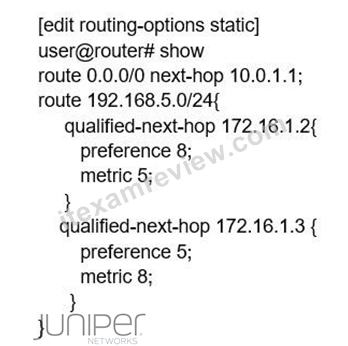
Referring to the configuration shown in the exhibit, which statement is true?
- A. Traffic destined to address 192.168.5.1 will take next-hop 10.0.1.1.
- B. Traffic destined to address 192.168.5.1 will take next-hop 172.16.1.2.
- C. Traffic destined to address 192.168.5.1 will alternate between next-hops 172.16.1.2 and 172.16.1.3
- D. Traffic destined to address 192.168.5.1 will take next-hop 172.16.1.3.
Answer: D
NEW QUESTION # 46
An OSPF router does not have a router ID configured.
In this scenario, which statement is correct about the router ID?
- A. The Junos OS will use the IP address assigned to the Interface with the highest priority.
- B. The Junos OS will use the IP address assigned to the loopback interface for the router ID.
- C. A router ID will not be assigned until it is manually configured.
- D. The Junos OS will use the IP address assigned to the interface with the lowest MAC address.
Answer: C
NEW QUESTION # 47
An OSPF router does not have a router ID configured.
In this scenario, which statement is correct about the router ID?
- A. The Junos OS will use the IP address assigned to the Interface with the highest priority.
- B. The Junos OS will use the IP address assigned to the loopback interface for the router ID.
- C. A router ID will not be assigned until it is manually configured.
- D. The Junos OS will use the IP address assigned to the interface with the lowest MAC address.
Answer: B
Explanation:
The router identifier is used by BGP and OSPF to identify the routing device from which a packet originated.
The router identifier usually is the IP address of the local routing device. If you do not configure a router identifier, the IP address of the first interface to come online is used. This is usually the loopback interface.
Otherwise, the first hardware interface with an IP address is used
In OSPF, if a router ID is not manually configured, Junos OS will automatically select the router ID based on the highest IP address of any of the router's loopback interfaces. If no loopback interface exists, the highest IP address of any active interface will be used. Therefore, answer C is correct.
References:
Juniper Networks documentation on OSPF: OSPF Overview
NEW QUESTION # 48
You want to see a detailed list of all established BGP sessions. In this scenario, what would be a valid command to accomplish this task?
- A. show bgp neighbor
- B. show rouse protocol bgp
- C. show rouse receive-protocol bgp <neighbor IP address>
- D. show bgp summary
Answer: A
Explanation:
Theshow bgp neighborcommand in Junos OS provides a detailed description of each BGP session, including session state, options configured, and counters for messages sent and received. This is the command you would use to see a detailed list of all established BGP sessions.
References:
Juniper Networks documentation on BGP: BGP Commands
NEW QUESTION # 49
Exhibit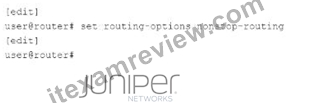
Referring to the exhibit, which two additional steps should you lake to fully configure NSR? (Choose two.)
- A. You should configure the max period for NSR precision timers.
- B. You must configure GRES.
- C. You should configure commit synchronization.
- D. You must configure graceful restart.
Answer: B,C
Explanation:
https://www.juniper.net/documentation/us/en/software/junos/high-availability/topics/task/nsr-configuring.html Nonstop routing (NSR) requires both Graceful Routing Engine Switchover (GRES) and commit synchronization to be configured to maintain routing protocol and forwarding state during a Routing Engine switchover. NSR allows the secondary Routing Engine to take over the control plane without the protocols needing to restart, and GRES ensuresthat the forwarding plane continues operating with the current forwarding table. Commit synchronization ensures that configuration changes are synchronized between the primary and backup Routing Engines.
References:
Juniper Networks documentation on High Availability: Configuring Nonstop Active Routing
NEW QUESTION # 50
You have an established LSP between your R1 and R5 devices using the configuration shown in the exhibit. You are asked to ensure that MPLS labels are used to forward traffic by all devices within the LSP.
Which action will accomplish this behavior?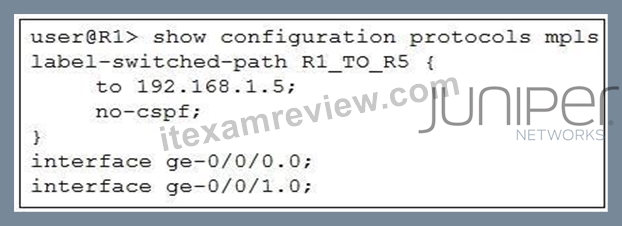
- A. Delete the no-cspf statement under the R1_TO_R5 label switched path on R1.
- B. Configure the ultimace-hop-popping statement under the R1_TO_R5 label switched path on R1.
- C. Configure the install statement under the R1_TO_R5 label switched path on R1.
- D. Configure the explicit-null statement under the protocol mpls hierarchy on R1.
Answer: C
Explanation:
https://www.juniper.net/documentation/us/en/software/junos/mpls/topics/ref/statement/install-edit-protocols-mpls.html
NEW QUESTION # 51
Exhibit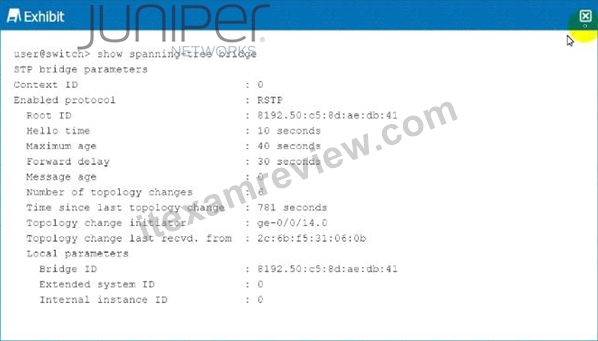
Which two statements are correct about the information shown in the exhibit? (Choose two.)
- A. The root bridge's priority Is 4k.
- B. The root bridge is reachable using the ge-0/0/14 interface.
- C. This switch has a bridge priority of 8k.
- D. This switch is the root bridge for this spanning tree topology.
Answer: B,C
Explanation:
The exhibit shows the output of the commandshow spanning-tree bridge, which provides information about the spanning tree status of the switch. From the output, we can see that the switch has a bridge ID different from the root ID, which implies that this switch is not the root bridge. The "Topology change initiator" field shows ge-0/0/14, which indicates that the last topology change occurred on this interface, and this is also the interface used to reach the root bridge.
References:
Juniper Networks documentation on Spanning Tree Protocol: Understanding Spanning Tree Protocols
NEW QUESTION # 52
Which two interface types are used as tunnel endpoints? (Choose two.)
- A. ip
- B. ae
- C. gr
- D. ge
Answer: A,C
Explanation:
tunnel-end-point name {
ipv4 {
source-address 10.255.1.1;
destination-address 10.255.2.0/25;
}
gre {
key 9;
}
}
https://www.juniper.net/documentation/us/en/software/junos/routing-policy/topics/ref/statement/tunnel-end-point-edit-firewall.html
NEW QUESTION # 53
Click the Exhibit button. Based on the configuration shown in the exhibit, what will be the state of the IS-IS levels on interface ge-0/0/0.100?
- A. Level 1 is disabled and Level 2 is enabled.
- B. Level 1 is enabled and Level 2 is disabled.
- C. Level 1 is enabled and Level 2 is enabled.
- D. Level 1 is disabled and Level 2 is disabled.
Answer: D
NEW QUESTION # 54
Which statement is correct about the FE80;:/10 prefix?
- A. This prefix range is not reserved.
- B. This prefix range is reserved for multicast applications
- C. This prefix range is used for the link local address.
- D. This prefix range is used on the loopback interface.
Answer: C
Explanation:
The FE80::/10 prefix is reserved for IPv6 link-local addresses. These addresses are auto-configured on all IPv6-enabled interfaces and can be used for communication within the local link (subnet) only.
Reference:
Juniper Networks Technical Documentation on IPv6 Addressing
NEW QUESTION # 55
Exhibit.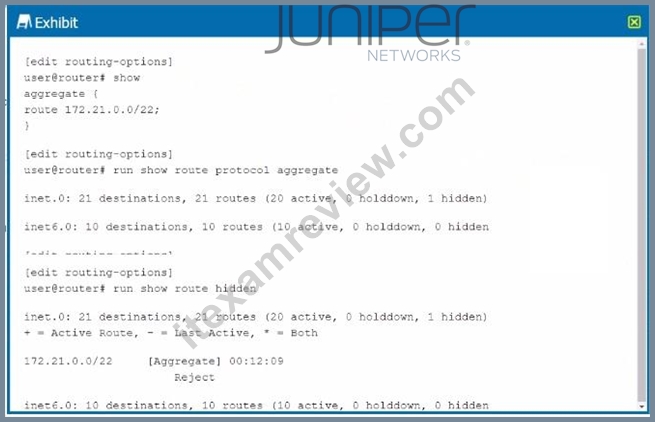
Referring to the exhibit, you have configured an aggregate route that represents the 172.21.0.0/24, 172.21.1.0/24, and 172.21.2.0/24 networks. However, when you view the routing table, your new route hidden.
Which action would you perform to determine the problem?
- A. Verify that you have configured a policy on the device to accept aggregate routes.
- B. Verify that you have active contributing routes on the device.
- C. Verify that you have set the preference to a lower default value.
- D. Verify that you have defined a metric value for the aggregate route.
Answer: C
NEW QUESTION # 56
Exhibit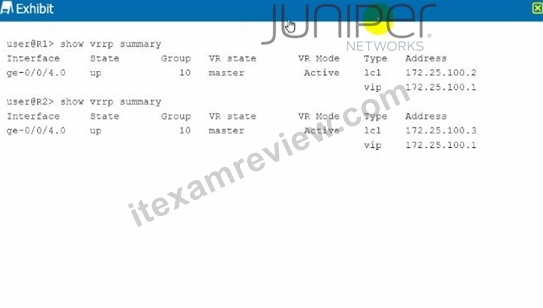
Referring to the exhibit, which statement is true about VRRP?
- A. The routers should use different virtual IP addresses for VRRP to function correctly.
- B. Both routers are in the same state because they have the same VRRP priority.
- C. VRRP communication between the two devices is not functioning correctly.
- D. VRRP Is functioning normally in active/active mode.
Answer: D
Explanation:
The exhibit shows the show vrrp summary output from two routers, with both routers listing the state of their VRRP group as master. VRRP allows for multiple routers to share a virtual IP address and a virtual MAC address, but usually, only one router is the master at any given time while others are in backup state. However, in some configurations, VRRP can operate in an active/active mode where multiple routers handle traffic simultaneously for load sharing. Since both routers show the state as master and there is no evidence of misconfiguration in the virtual IP addresses or priority, it indicates that VRRP is likely functioning in an active/active setup.
Reference:
Juniper documentation on VRRP: Junos OS VRRP Overview
NEW QUESTION # 57
Click the Exhibit.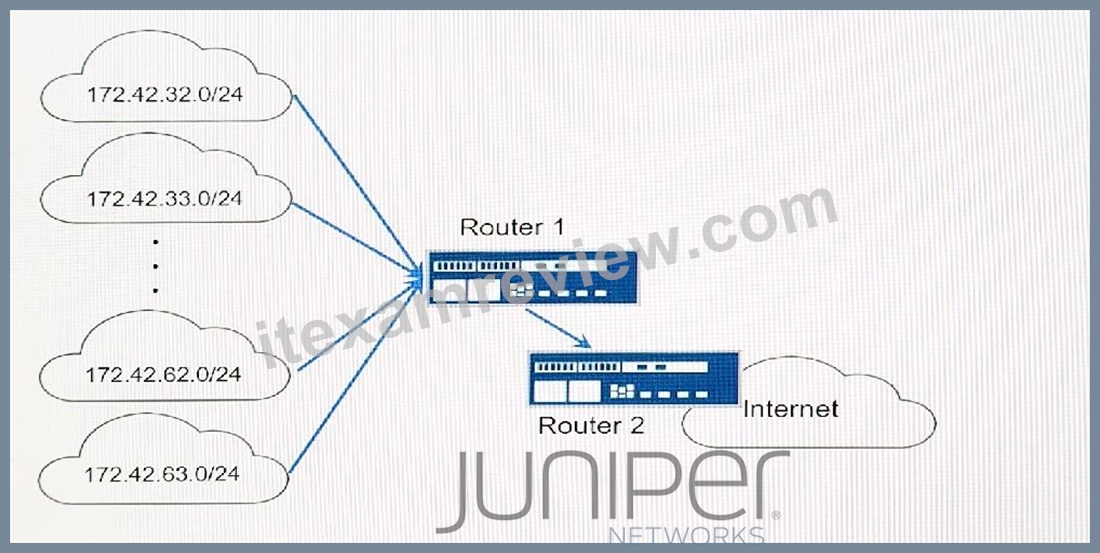
Your network consists of subnets shown in the exhibit. You are asked to create an aggregate route for Router 1.
What is the appropriate prefix for the aggregate route in this scenario?
- A. 172.42.32.0/20
- B. 172.42.32.0/22
- C. 172.42.32.0/21
- D. 172.42.32.0/19
Answer: D
NEW QUESTION # 58
Click the Exhibit.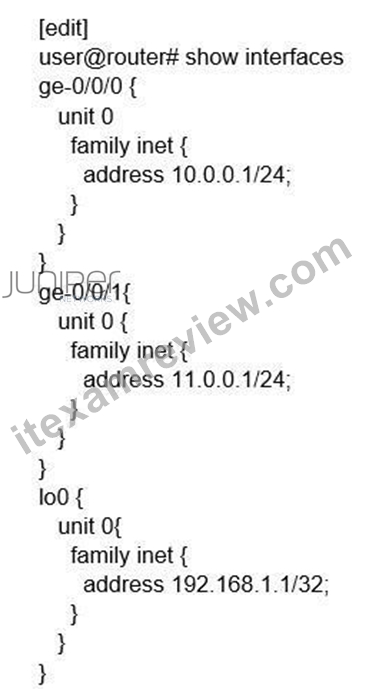
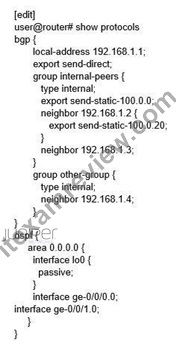
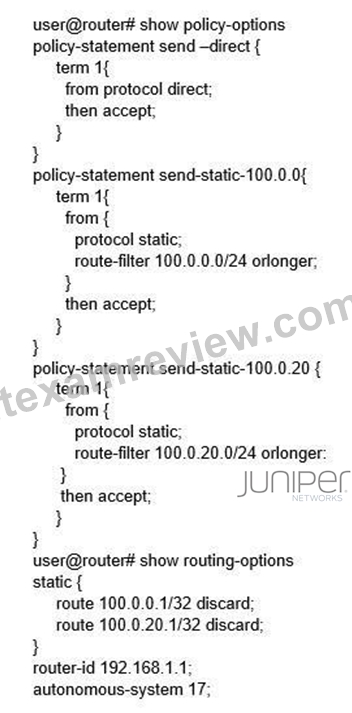
Referring to the exhibit, which route(s) will be exported to neighbor 192.168.1.2?
- A. 100.0.20.1/32
- B. 10.0.0.0/24, 11.0.0.0/24,100.0.0.1/32, 100.0.20.1/32, and 192.168.1.1/32
- C. 100.0.1/32 and 100.0.20.1/32
- D. 100.0.20.1/32, 192.168.1.1/32, and 100.0.0.1/32
Answer: B
NEW QUESTION # 59
......
The JN0-363 exam is a comprehensive assessment of a candidate's understanding of service provider routing and switching technologies, including Junos OS fundamentals, routing policy and firewall filters, MPLS and multicast protocols, and high availability and scaling techniques. JN0-363 exam is available in English and Japanese and consists of multiple-choice questions, drag-and-drop questions, and simulation questions.
Latest JN0-363 Pass Guaranteed Exam Dumps with Accurate & Updated Questions: https://www.itexamreview.com/JN0-363-exam-dumps.html
Pass JN0-363 Exam with Updated JN0-363 Exam Dumps PDF 2025: https://drive.google.com/open?id=1cMfxJGEJ-Wm0SdKpNneQqf5muwFa7MYf
