

Ensure Success With Updated Verified NEX Exam Dumps [2026]
Exam Materials for You to Prepare & Pass NEX Exam.
NEW QUESTION # 17
Where does saltatory conduction occur?
- A. Myelinated axons
- B. Unmyelinated axons
- C. Muscle cells
- D. Dendrites
Answer: A
Explanation:
Saltatory conduction is the rapid transmission of nerve impulses alongmyelinated axons. In myelinated neurons, the axon is covered with a fatty insulating layer called myelin, which is interrupted at gaps known as nodes of Ranvier. During saltatory conduction, the electrical impulse "jumps" from one node to the next, greatly increasing the speed of signal transmission. Unmyelinated axons conduct impulses more slowly because the signal must travel continuously along the entire membrane. Dendrites receive signals rather than transmit them over long distances, and muscle cells do not conduct nerve impulses in this manner. The NEX Science exam commonly tests nervous system physiology, particularly mechanisms that improve conduction speed, making myelinated axons the correct answer.
======
NEW QUESTION # 18
In the human male, which of these structures produces sperm cells?
- A. Testes
- B. Prostate gland
- C. Epididymis
- D. Cowper's glands
Answer: A
Explanation:
Sperm cells are produced in thetestes, specifically within tightly coiled structures called seminiferous tubules.
The process of sperm production is known as spermatogenesis and requires hormones such as testosterone.
Cowper's glands and the prostate gland do not produce sperm; instead, they secrete fluids that contribute to semen and help protect and nourish sperm cells. The epididymis is responsible for sperm maturation and storage but does not produce sperm. The NEX Science exam often tests reproductive anatomy by asking students to distinguish between sperm production, maturation, and transport. Understanding the specific role of each male reproductive structure is essential. Since only the testes are responsible for the formation of sperm cells, option C is the correct answer.
NEW QUESTION # 19
Review the scatter plot of hours students studied for a test and their results.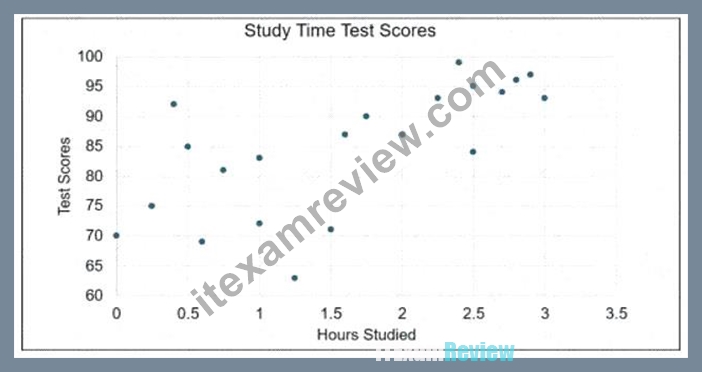
What can you conclude from the graph?
- A. As hours studied increase, test scores tend to increase.
- B. As hours studied increase, test scores tend to decrease.
- C. Test scores are higher when no hours are spent studying.
- D. There is no relationship between hours studied and test scores.
Answer: A
Explanation:
This question tests interpretation of scatter plots and correlation. In the graph, the horizontal axis represents hours studied, and the vertical axis represents test scores. As the points move from left to right (indicating more hours studied), the points also tend to move upward (indicating higher test scores). This shows a positive relationship between the two variables. While not every point follows a perfect line, the overall trend clearly indicates that students who studied more hours generally achieved higher test scores. Option B correctly describes this positive correlation. Option A is incorrect because scores are not highest when no studying occurs. Option C is incorrect because there is a visible relationship. Option D describes a negative relationship, which is not shown. On the NEX exam, scatter plots are often used to test understanding of trends rather than exact values, so identifying the overall direction of the data is key.
======
NEW QUESTION # 20
Word Knowledge
The word"contribute"most nearly means:
- A. Remove
- B. Prevent
- C. Ignore
- D. Add to
Answer: D
Explanation:
To contribute means to add to or help bring about a result. Option B is the correct synonym. The other options describe the opposite action. NEX vocabulary often includes cause-and-effect language.
======
NEW QUESTION # 21
Which fraction is equal to 0.04?
- A. 2/5
- B. 2/50
- C. 1/4
- D. 2/500
Answer: B
Explanation:
This question tests your ability to convert between decimals and fractions, a very common skill on the NEX Math Section. Start by understanding the decimal value. The decimal 0.04 means four hundredths, which can be written as the fraction 4/100. The next step is to simplify this fraction by dividing both the numerator and the denominator by their greatest common factor, which is 2. Doing so gives 2/50. That fraction exactly matches option C, making it the correct answer. To verify, you can also convert 2/50 back into a decimal by dividing 2 by 50, which equals 0.04. The other options are incorrect because they represent much larger values. For example, 1/4 equals 0.25, 2/5 equals 0.4, and 2/500 equals 0.004. On the NEX exam, remembering that two decimal places correspond to hundredths can help you quickly form the correct fraction before simplifying.
======
NEW QUESTION # 22
A symbiotic relationship where one organism benefits and the other is neither helped nor harmed is referred to as
- A. commensalism.
- B. parasitism.
- C. predation.
- D. mutualism.
Answer: A
Explanation:
Commensalism is a type of symbiotic relationship in which one organism benefits while the other is unaffected. An example is barnacles attaching to whales, where the barnacles gain transportation and access to food, while the whale is neither helped nor harmed. Mutualism benefits both organisms, parasitism benefits one while harming the other, and predation involves one organism killing another for food. Understanding ecological relationships is a key topic on the NEX Science exam, and recognizing the differences between types of symbiosis is essential.
======
NEW QUESTION # 23
Which of the following will increase the amount of oxygen produced by a plant?
- A. Increase available carbon dioxide
- B. Decrease available glucose
- C. Increase available glucose
- D. Decrease available carbon dioxide
Answer: A
Explanation:
Oxygen is produced during the process of photosynthesis, which occurs in the chloroplasts of plant cells.
During photosynthesis, plants use carbon dioxide, water, and light energy to produce glucose and oxygen.
Carbon dioxide is one of the key raw materials required for this process. When the availability of carbon dioxide increases, the rate of photosynthesis can also increase, assuming that light and water are not limiting factors. As photosynthesis increases, more oxygen is released as a byproduct. Decreasing carbon dioxide would slow photosynthesis and reduce oxygen production. Glucose is a product of photosynthesis, not a reactant, so changing glucose levels does not directly increase oxygen output. Therefore, increasing available carbon dioxide is the correct answer. The NEX Science exam frequently tests understanding of the inputs and outputs of photosynthesis and how environmental factors affect the process.
======
NEW QUESTION # 24
You are designing a new community public health program to reduce the incidence of cardiovascular diseases (CVD) in your county.
Which of the following programs would likely result in the best overall outcome?
- A. Disease prevention (e.g., cholesterol screenings)
- B. Disease education (e.g., symptoms, causes, and treatment)
- C. Disease prevention and health promotion
- D. Health promotion activities (e.g., nutrition, exercise, stress management classes)
Answer: C
Explanation:
Combining disease prevention and health promotion provides the greatest overall impact on reducing cardiovascular disease. Prevention identifies and manages risk factors early, while health promotion encourages long-term lifestyle changes such as healthy eating, exercise, and stress reduction. Education alone increases awareness but may not change behavior. Screening without lifestyle intervention has limited long- term effectiveness. The NEX Science exam emphasizes population health strategies, making integrated prevention and promotion the most effective approach.
======
NEW QUESTION # 25
The figure below represents the human eye.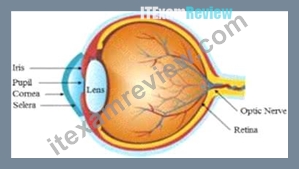
Where are the rods and cones located?
- A. Optic nerve
- B. Cornea
- C. Lens
- D. Retina
Answer: D
Explanation:
Rods and cones are specialized photoreceptor cells responsible for vision. These cells are located in the retina, the innermost layer of the eye. The retina contains multiple layers of cells that convert light energy into electrical impulses, which are then transmitted to the brain through the optic nerve. Rods are highly sensitive to light and are essential for vision in dim conditions, while cones are responsible for color vision and sharp visual detail. The cornea and lens help focus light but do not detect it. The optic nerve transmits signals but does not contain photoreceptors. The NEX Science exam frequently tests eye anatomy and sensory physiology, especially the relationship between structure and function. Correctly identifying the retina as the location of rods and cones is essential for understanding how visual perception occurs.
======
NEW QUESTION # 26
Word Knowledge
The word"precaution"most nearly means:
- A. Risk
- B. Warning
- C. Preventive measure
- D. Emergency
Answer: C
Explanation:
A precaution is an action taken to prevent harm or reduce risk. Option C best matches this meaning. NEX questions frequently use safety-related vocabulary.
======
NEW QUESTION # 27
Which of the following bones form the ball-and-socket joint of the upper extremity?
- A. Scapula, humerus
- B. Ribs, humerus
- C. Humerus, clavicle
- D. Scapula, clavicle
Answer: A
Explanation:
The ball-and-socket joint of the upper extremity is the shoulder joint. This joint is formed by the head of the humerus (the ball) fitting into the glenoid cavity of the scapula (the socket). This structure allows for a wide range of motion, including flexion, extension, abduction, adduction, and rotation. The ribs do not participate in this joint, and the clavicle connects the scapula to the sternum but does not form the ball-and-socket articulation. Understanding joint structure and function is important for anatomy questions on the NEX Science exam. The shoulder joint's design allows greater mobility than stability, which explains why shoulder dislocations are relatively common.
======
NEW QUESTION # 28
The graph below displays survey results.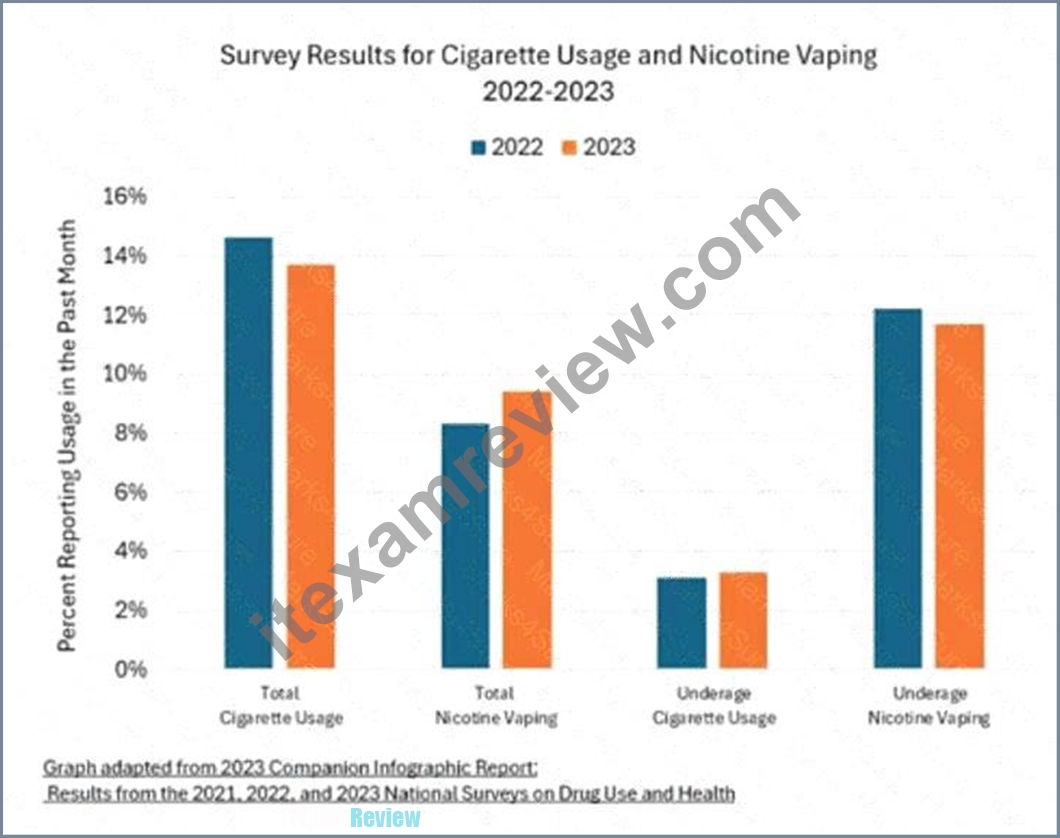
Data in the graph indicate that
- A. vaping is more prevalent than using cigarettes in the total population.
- B. underage nicotine vaping increased in 2023.
- C. vaping is more prevalent than using cigarettes in the underage population.
- D. total cigarette usage increased in 2023.
Answer: C
Explanation:
This question tests the ability to analyze and compare data presented in a bar graph. The graph shows both cigarette usage and nicotine vaping for total populations and underage populations in two different years.
When focusing on the underage population, the bars for nicotine vaping are clearly higher than those for cigarette usage in both years shown. This indicates that vaping is more prevalent than cigarette smoking among underage individuals. The graph does not show an increase in total cigarette usage, eliminating option B: While vaping is high overall, the clearest and most directly supported conclusion is specific to the underage population. The NEX Science exam frequently includes questions requiring students to identify the most accurate conclusion supported by data rather than making assumptions beyond what is shown.
Therefore, option A is the best answer.
======
NEW QUESTION # 29
Which of the following pictures reflects the effect on red blood cells when plain water is infused into a person?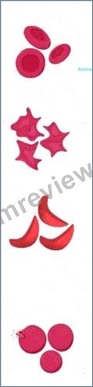
- A. Swollen and bursting red blood cells
- B. Curved, sickle-shaped red blood cells
- C. Shriveled, spiky red blood cells
- D. Normal, biconcave red blood cells
Answer: A
Explanation:
This question tests understanding of osmosis and tonicity, which are frequently assessed on the NEX Science exam, especially in physiology-related contexts. Plain water ishypotoniccompared to the fluid inside red blood cells. When red blood cells are placed in a hypotonic solution, water movesintothe cells by osmosis because water flows from an area of lower solute concentration to higher solute concentration. As water enters the red blood cells, they swell. If too much water enters, the cells can burst in a process calledhemolysis
. The correct image therefore shows enlarged, rounded red blood cells that may appear ruptured. Normal biconcave cells indicate an isotonic environment, while shriveled or spiky cells occur in a hypertonic solution.
Sickle-shaped cells are related to a genetic disorder and are not caused by osmotic changes. The NEX exam often emphasizes patient safety concepts, including why plain water should never be infused intravenously.
NEW QUESTION # 30
The four main types of macromolecules found in our cells are lipids, carbohydrates, proteins, and
- A. fatty acids.
- B. nucleic acids.
- C. unsaturated fats.
- D. phospholipids.
Answer: B
Explanation:
Macromolecules are large, complex molecules essential for life. The four major classes of biological macromolecules are carbohydrates, lipids, proteins, and nucleic acids. Carbohydrates provide energy and structural support, lipids are involved in energy storage and membrane structure, proteins perform a wide range of functions including enzymes and transport, and nucleic acids store and transmit genetic information.
DNA and RNA are examples of nucleic acids. The other answer choices-fatty acids, unsaturated fats, and phospholipids-are all types of lipids rather than separate macromolecule categories. The NEX Science exam often assesses whether students can distinguish between macromolecule categories and their subcomponents.
Recognizing nucleic acids as one of the four major macromolecules is fundamental to understanding genetics, protein synthesis, and cell function.
======
NEW QUESTION # 31
A recipe for pancakes serves 4 people and requires 1.5 cups of flour.
If the cook wants to make enough pancakes to serve 8 people, how much flour is needed?
- A. 8 cups
- B. 3 cups
- C. 1.5 cups
- D. 5.5 cups
Answer: B
Explanation:
This is a proportional reasoning problem. If 4 people require 1.5 cups of flour, then doubling the number of people to 8 means doubling the amount of flour. Multiply 1.5 by 2:
1.5 × 2 = 3 cups.
Therefore, option D is correct. Option A is the original amount, not scaled. Option B greatly overestimates the amount. Option C results from incorrect multiplication. The NEX frequently includes scaling problems related to recipes, dosages, and supplies, so identifying when to multiply or divide is essential.
======
NEW QUESTION # 32
Reading Comprehension
Passage:
Clear documentation in healthcare settings ensures continuity of care. Accurate records allow providers to understand patient history and make informed decisions.
Why is documentation important according to the passage?
- A. It reduces provider workload
- B. It eliminates medical errors
- C. It ensures continuity of care
- D. It replaces direct patient care
Answer: C
Explanation:
The passage clearly states that documentation ensures continuity of care by allowing healthcare providers to understand patient history and make informed decisions. Option B directly reflects this purpose. The passage does not claim that documentation replaces care, eliminates all errors, or reduces workload. NEX passages often emphasize communication and record-keeping as foundational healthcare skills, making continuity of care a key concept.
======
NEW QUESTION # 33
Prepared bottles contain 120 milliliters (mL) of infant formula. An infant drinksbottle every 2 hours for each of their 6 daytime feedings.
Given 1 ounce = 30 mL, how many ounces did the infant drink?
- A. 0
- B. 1
- C. 2
- D. 3
Answer: A
Explanation:
This is a multi-step dosage and unit-conversion problem. Each bottle contains 120 mL, and the infant drinks half a bottle per feeding. Half of 120 mL is 60 mL. The infant has 6 feedings, so total intake is 60 × 6 = 360 mL. Convert milliliters to ounces using the given conversion: 360 ÷ 30 = 12 ounces. Therefore, option C is correct. Option D represents milliliters, not ounces. Option B incorrectly doubles the intake. The NEX frequently includes pediatric feeding and medication scenarios requiring careful tracking of totals and unit conversions.
======
NEW QUESTION # 34
......
Updated NEX Certification Exam Sample Questions: https://www.itexamreview.com/NEX-exam-dumps.html
Pass Your NEX Exam at the First Try with 100% Real Exam: https://drive.google.com/open?id=1hSnVDXqTaoq3Pb41nLee3O3CjoHHPtRk
